

Can you drink hard water? Hard water contains dissolved calcium and magnesium, and the WHO does not set a health-based limit for hardness. Most healthy adults can drink hard water safely. A high TDS level in water does not directly cause kidney stones. In Delhi, the groundwater has documented risks of salinity, uranium, and nitrate. The TDS meter alone cannot identify these. So what should you do if your building uses borewell water? In this guide, you will learn whether you can drink hard water and what measurements to follow.
Does Drinking Hard Water Cause Kidney Stones?
No, there is no medical evidence that drinking hard water causes kidney stones. A high TDS level on a TDS meter should not be taken as a warning for kidney stones.
When you heat hard water, the dissolved calcium and magnesium bicarbonates become insoluble carbonates and settle on the metal. The WHO says that the TDS above 500 mg/L causes ‘excessive scaling’ in pipes, steam irons, and kettles.
What Does the White Scaling Mean?
Excessive scaling becomes a real concern. If the water leaves a coat on steel in a few weeks, can hard water affect our kidneys? A kettle and the human body handle minerals differently. A kettle boils water and leaves solids behind. The body regulates how much calcium the gut absorbs. If your body absorbs more than it needs, healthy kidneys excrete the excess.
Also Read: Can You Reuse RO Waste Water? 6 Ways To Use Reject RO Water!
Why Doesn’t Calcium Turn into Kidney Stones?
Most kidney stones are calcium oxalate. You will find oxalate in foods such as spinach, nuts, and wheat bran. If the calcium reaches your gut at the same time, it can bind to oxalate there.
The WHO acknowledges that “dietary calcium reduces the incidence of kidney stones.” However, a large trial shows that calcium supplements can be linked to a higher risk of kidney stones. This happens because the calcium was taken as a single dose rather than with food.
What Actually Increases the Risk of Kidney Stones?
There are a few things that you need to know to prevent the risk of kidney stones:
- Low fluid intake, which concentrates urine
- High sodium from salt, packaged food and condiments
- Large amounts of animal protein
- High-oxalate foods, for people prone to calcium oxalate stones
- Excess body weight
For Delhi, there is something specific to consider. If your building has a high TDS level and you don’t drink enough water in summer because of the taste, you may form stones. If you already have a history of kidney stones, follow your doctor’s advice.
Also Read: Do You Need an RO Water Purifier for Borewells in Delhi?
What Does TDS in Hard Water Actually Mean?
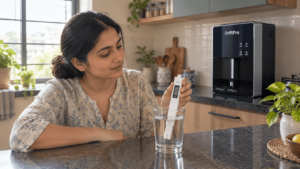
A hard water TDS reading measures everything dissolved in the water. It doesn’t focus on hardness alone. TDS meters show a figure that includes magnesium and calcium.
Hardness counts calcium and magnesium, shown as calcium carbonate. The WHO states that water hardness below 60 mg/L is soft, 60-120 mg/L is moderately hard, 120-180 mg/L is hard, and above 180 mg/L is very hard.
Two homes can have the same TDS reading; let’s say, 600 ppm. However, the source of that hardness can differ. One supply can carry calcium, and the other mostly salt.
Also Read: Water TDS Level in Delhi: Safe Limits and the Right Purifier
Should You Drink Hard Water?
Hard water contains minerals, but whether you benefit from drinking water is not proven. The WHO states that calcium and magnesium are crucial for health, and a low intake of either can be detrimental.
Do Water Minerals Count in Your Diet?
Drinking water adds a small share of minerals, but it varies. Most people get calcium and magnesium from food. According to the WHO, about 99% of the body’s roughly 1,200 g of calcium is found in bones and teeth. Water can bring a small amount of calcium into that total; however, it is not a replacement for dairy, leafy greens, or pulses.
Some studies found that cardiovascular diseases decreased as magnesium in water rose, mainly at about 10 mg/L and above. However, calcium does not show any such connection. The WHO does not release any minimum or maximum mineral guidelines.
The Real Problem with Delhi Groundwater and its Hardness
Whether you can drink hard water depends on the TDS level. Substances such as calcium and magnesium make water hard. However, you cannot overlook uranium, nitrate, or fluoride. The Central Ground Water Board tested 103 groundwater samples in Delhi and found the following:
| Parameter (CGWB Delhi, Dec 2024) | Permissible limit | Samples above limit | Share of samples | Districts with high readings |
| Electrical conductivity (salinity) | 3,000 µS/cm | 24 of 103 | 23.3% | North, North West, Shahdara, South West, West |
| Nitrate | 45 mg/L | 21 of 103 | 20.39% | New Delhi, North, North West, South, South East, South West, West |
| Fluoride | 1.5 mg/L | 17 of 103 | 16.5% | New Delhi, North, North West, Shahdara, South, South West |
| Uranium | 30 ppb | 11 of 103 | 10.7% | North, North West, South, South East, South West, West |
| Arsenic | 10 ppb | 3 of 103 | 2.91% | East, South East |
Source: CGWB, Dynamic Ground Water Resources & Ground Water Quality of Delhi, 2024 (December 2024). The CGWB describes these as anomalous values at sporadic locations, not district-wide readings.
Hard Water TDS Levels in Delhi Borewells
TDS in Delhi groundwater can be high enough to fail on taste before health even comes into play. The CGWB’s salinity cut-off of 3,000 µS/cm works out to roughly 1,650-2,100 ppm of TDS.
The WHO says TDS in water above 1,200 mg/L is unacceptable. The BIS sets the acceptable limit at 500 mg/L, which can be relaxed to 2,000 mg/L when no other source exists.
Why Does a TDS Meter Fail to Detect Uranium or Fluoride?
A TDS meter does not tell you whether you can drink hard water. It cannot tell you what makes up the total. The amounts that matter for health are small compared with that total. The BIS fluoride limit is 1.5 mg/L, and the uranium limit is 30 parts per billion.
A borewell in North West Delhi and another one in East Delhi may have the same TDS reading. However, these two supplies carry different risks. You need to send your water for a lab test to get detailed results for nitrate, arsenic, and uranium.
Do You Need an RO Purifier for Hard Water in Delhi?
Your home needs an RO system when your water contains dissolved substances that boiling and filtering cannot remove. If the water has very high TDS, nitrate, arsenic, and fluoride, you will need an RO water purifier.
| Reading | What it means | Typical treatment |
| TDS below 300 ppm | WHO taste rating: “excellent.” | UV + UF purifier for microbes. RO usually not needed for minerals. |
| TDS 300–500 ppm | Within the BIS acceptable limit of 500 mg/L. Taste still “good” by WHO bands. | UV + UF if the lab report is clean. RO if taste or scaling bothers the household. |
| TDS 500–2,000 ppm | Above the BIS acceptable limit. Tolerated only without an alternative source. | RO with mineral or TDS control. |
| TDS above 2,000 ppm | Above the BIS permissible limit. Source should be rejected for drinking. | RO rated for high input TDS. Check the purifier’s maximum feed TDS. |
| Nitrate, fluoride, arsenic or uranium above BIS limits | Health risk at any TDS reading. | RO, after a lab test confirms the contaminant. |
Also Read: When Should You Change Your RO Filter? Signs To Look Out For!
What is the Safe TDS for Drinking Water?
There is no single safe TDS level in water. The WHO says water with extremely low concentrations of TDS may taste flat and insipid – it is often corrosive to pipes. You can drink hard water with an RO purifier; however, you still need the minerals back.
To maintain a good TDS level, avoid stripping minerals to near zero. Instead, focus on removing harmful dissolved substances – nitrate, arsenic, fluoride, or chloride.
Do You Need an MTDS Controller and Mineral Cartridges?
A manual TDS or MTDS controller is a valve that mixes a small amount of non-purified water back into the RO-purified water to increase the output TDS. A mineral cartridge, also known as a mineral enhancer or TDS infuser, can add calcium and magnesium back to water after the RO purification.
If you are drinking hard water in Delhi, check whether the water source contains nitrate or fluoride above BIS limits. A high MTDS setting can return some of it. If a lab report shows the contaminants, you can keep the MTDS setting low and rely on a mineral cartridge for taste. You can drink hard water after purification – check the blended output for safety.
Also Read: Best Water Purifier for Home in Delhi (2026): A Complete Guide
Should You Rent an RO Purifier with MTDS Controller in Delhi?
Rentomojo, a furniture and appliance rental platform, offers RO water purifiers for rent in different ranges. You will find RO+UV+UF units with mineral enhancer or TDS infuser stages. Some partner-listed units also feature an MTDS controller with alkaline and mineral cartridges.
Renting a water purifier is suitable for tenants in Delhi for a particular reason. Before you drink hard water, know that the TDS varies by neighbourhood. A purifier suited to piped supply may not work with borewell water. Rentomojo covers repairs, maintenance, and filter changes every six months. All plans also include free relocation if you need to move to another apartment. For more information, check out Rentomojo’s water purifiers for rent in Delhi!