

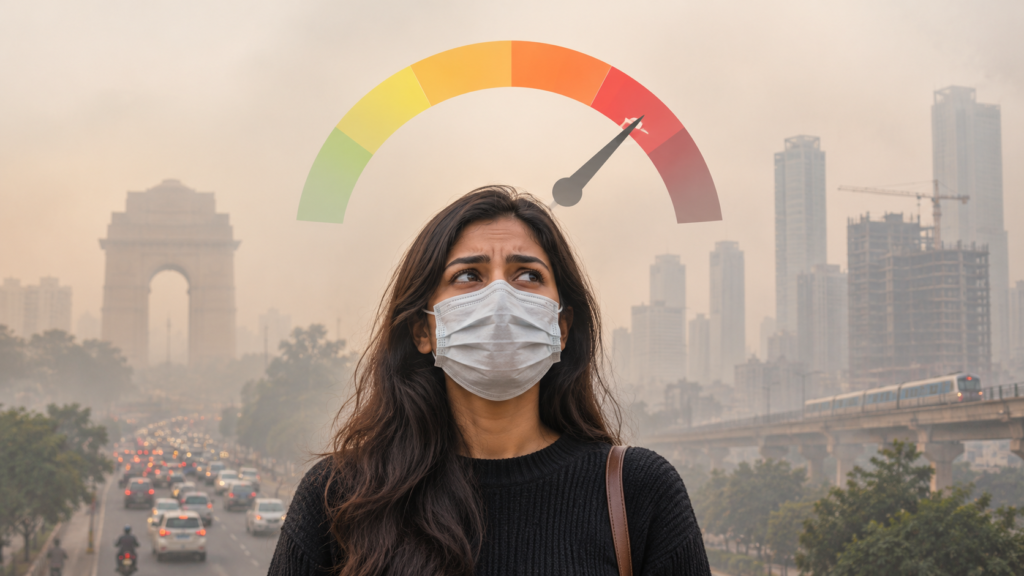
The air quality in Gurgaon isn’t cleaner than Delhi’s; it is under-measured. It often posts a lower AQI, but its high-rise, DG-backed, commute-heavy lifestyle adds exposure that the city AQI stat misses. In March 2026, Gurgaon ranked as India’s most polluted city, with a monthly average PM2.5 concentration of 116 µg/m³, meaning people in Gurgaon were inhaling twice the amount of fine dust as recommended by NAAQS. A reading on 9 November 2026 showed Gurgaon’s AQI spiking to 345, with Delhi’s AQI at 344.
On 6 November 2026, the Commission for Air Quality Management (CAQM) invoked Stage III of the Graded Response Action Plan (GRAP) in Delhi-NCR as air quality continued to remain in the ‘very poor’ category.
Also Read: Does an Air Purifier Work in Delhi? Find Out Everything Here!
What Is AQI, and How Is It Measured?
The Air Quality Index (AQI) is a standardised measure of how good or polluted the air quality around you is, along with the health risks that come with it. Here are the 8 pollutants that make up the AQI measurement:
- Fine dust (PM2.5),
- Larger dust (PM10)
- Ozone (O3 )
- Nitrogen dioxide
- Sulphur dioxide
- Carbon monoxide
- Ammonia
- Lead
The AQI is measured on a scale of 0 to 500, where a lower score means cleaner, safer air. So, a city with an AQI of 40 is doing well, while a city at 400 needs serious attention. As the air pollution rises, so do the AQI and the associated health risks.
The Central Pollution Control Board (CPCB) in India is the regulatory body that monitors each city and publishes the 24-hour average score.
| AQI | Category | What it means for you |
| 0–50 | Good | Minimal impact |
| 51–100 | Satisfactory | Minor discomfort for sensitive people |
| 101–200 | Moderate | Discomfort for people with lung or heart conditions, children and older adults |
| 201–300 | Poor | Breathing discomfort for most people on long exposure |
| 301–400 | Very poor | Breathing problems on long exposure |
| 401–500 | Severe | Affects healthy people; serious for those with existing conditions |
Why Does AQI App Show Different Numbers for Gurgaon and Delhi?
It’s very likely that your AQI app and the news show different air quality in Gurgaon, but neither of them is wrong; it’s just that they read the air differently. AQI varies from region to region.
| Reason | What it means |
| Different scales | Apps like IQAir use the US AQI, which rates the same air as worse than India’s scale |
| Different time windows | The CPCB gives a 24-hour average; apps show the latest hourly reading |
| Fewer stations | Gurgaon has far fewer monitors than Delhi |
| Station placement | Two Gurgaon stations about 1 km apart record different levels |
Where Does Gurgaon Stand Amongst India’s Most Polluted Cities List in 2026?
As a matter of fact, the air quality in Gurgaon kept changing its rank through 2026. Gurgaon ranked at the top in March 2026 for having the most polluted air quality, and by October 2026, it was nowhere to be seen in the top 10 list.
The Centre for Research on Energy and Clean Air (CREA) ranks Indian cities every month using CPCB data.
October 2026: The Latest Rankings
Number of days in each air quality category (based on daily PM2.5, µg/m³):
| Rank | City | State | Good (0–30) | Satisfactory (31–60) | Moderate (61–90) | Poor (91–120) | Very poor (121–250) |
| 1 | Baraut | Uttar Pradesh | 1 | 4 | 14 | 5 | 5 |
| 2 | Khora | Uttar Pradesh | 1 | 2 | 17 | 9 | 2 |
| 3 | Gajraula | Uttar Pradesh | 1 | 6 | 13 | 9 | 2 |
| 4 | Yamunanagar | Haryana | 0 | 6 | 12 | 8 | 1 |
| 5 | Ghaziabad | Uttar Pradesh | 0 | 7 | 9 | 14 | 1 |
| 6 | Manesar | Haryana | 3 | 7 | 9 | 9 | 3 |
| 7 | Gummidipoondi | Tamil Nadu | 0 | 9 | 14 | 7 | 1 |
| 8 | Bahadurgarh | Haryana | 1 | 6 | 16 | 6 | 2 |
| 9 | Noida | Uttar Pradesh | 0 | 6 | 18 | 5 | 2 |
| 10 | Meerut | Uttar Pradesh | 1 | 7 | 18 | 2 | 3 |
Source: CREA, India monthly ambient air quality snapshot, October 2026.
What Makes Air Quality in Gurgaon Different From Delhi’s?
Many people saw Gurgaon as a slightly cleaner option compared to Delhi’s winter haze, but 2026 showed Gurgaon covered in a blanket of smog, thick haze and a grey sky. Let’s see what caused this change and how.
Why Is Delhi’s Air Worse Than Gurgaon’s?
| Factor | Delhi | Gurgaon | Significance to the AQI |
| People and traffic | Larger population, bigger road network, far more vehicles, daily jams | Smaller population, fewer vehicles | More people, more vehicles means a lot of exhaust, which makes Delhi’s air heavier. |
| Industry | Several factories spread across the industrial areas within Delhi | This Millennium City mostly has offices and homes; Manesar is the main factory belt. | Chimneys are closer, and the factory smoke adds up to Delhi’s AQI. |
| Stubble smoke | The smoke from burning crop waste in Punjab and Haryana is carried into Delhi. | The same smoke and dust reaches Gurgaon, but only less of it. | Delhi’s AQI rises in October and November as it takes the hit of the crop smoke. |
| Winds near the ground | Wind can’t pass through tall and dense buildings, which leads the dust and smoke to hang around. | Gurgaon has a different land and city layout, so air moves differently. | When air can’t move, dust and smoke pile up and the AQI shoots up. |
Why Gurgaon’s AQI Still Runs High
Despite fewer cars and less crop smoke than Delhi, Gurgaon’s AQI stays high due to its own seasonal and local factors. With too much construction happening at the same time, this results in construction and road dust, smoke and exhaust in the air due to the open burning of garbage, diesel and vehicles, shrinking green cover, and sudden weather changes when the temperature drops. Even on days when Delhi’s AQI is worse, Gurgaon’s AQI stays high.
Also Read: Do You Need An Air Purifier For Home? Find Out The Truth!
Why Does Gurgaon’s Air Get Worse in Winter?
Because in winter, when the temperature drops, the density of the cold air increases, which makes it difficult for the particulates to pass through the dense air. So when we should be seeing fog in winter, we see smog, a combination of smoke and fog. All the dust, smoke, and exhaust from the automobiles, industries and factories gets trapped in the atmosphere.
Here’s what drives it in each season:
| Season | What drives it | How the air usually is |
| Winter (November–January, worst in December) | Slow winds, cold air trapping pollution, stubble smoke | “Poor” to “very poor” |
| Diwali | Fireworks on top of winter smog | “Very Poor” |
| Summer (May–June) | Dusty winds, dust storms | “Moderate” to “Poor” |
| Monsoon | Rain washes pollutants out of the air | “Satisfactory” to “Moderate” |
How Can Air Quality in Gurgaon and Delhi-NCR Be Improved?
In order to improve air quality, it takes more than seasonal bans by the government. The pollution and the factors adding to it need to be cut at the source; the rules need to be enforced and followed strictly, and residents should avoid their everyday habits like open waste burning, etc.
And for the improvement to last long, we must ensure that the actions that we take to curb the pollution are consistent.
The Government’s Plan: What Is GRAP?
GRAP stands for Graded Response Action Plan, an emergency rulebook, managed and operated by the Commission for Air Quality Management (CAQM). It is a step-by-step plan for what must be done when the air quality gets worse. This rulebook has four stages, and each stage introduces stricter rules as the AQI gets worse.
Let’s see what each stage entails:
| Stage | When it applies | Key steps |
| I | Poor air (AQI 201–300) | Mechanised road sweeping and water sprinkling; no coal or firewood in restaurant tandoors; diesel generators for emergency use only; older inter-state buses (BS-IV and below) barred |
| II | Very poor air (AQI 301–400) | Higher parking fees to discourage private cars; staggered timings for public offices in Delhi, Gurugram and nearby cities |
| III | Severe air (AQI 401–450) | Most construction and demolition halted; BS-III petrol and BS-IV diesel cars barred in Gurugram and other NCR districts; primary classes can move to hybrid mode |
| IV | Severe+ air (AQI above 450) | The strictest curbs, including a wider construction ban and limits on older trucks |
For the full list of measures and the stage currently in force, visit the CAQM website.
How Can You Be a Part of the Solution and Be Safe?
GRAP sets the rules, but our everyday choices will make the difference in curbing air pollution. Some choices remove or reduce the pollution you add, while others protect you from the pollution you already live around.
To pollute less:
| Your Actions | The Impact |
| Use public transport, carpool, work from home (if possible) | Fewer vehicles on the road means less exhaust |
| Avoid burning crops and garbage in open | It reduces smoke and toxic gases in the air and helps maintain a breathable environment |
| Keep your vehicle’s engine checked and tyres at the right pressure | Periodic vehicle maintenance helps burn fuel cleanly and releases less smoke. |
| Report Pollution on CPCB’s Sameer App | Helps the authorities to manage the garbage fires and dusty sites proactively |
| Separate wet, dry and electronic waste at home | Waste segregation at source means fewer landfill fires |
To protect yourself:
| Actions | Why it helps |
| Check the CPCB AQI before going out | Plan errands for cleaner hours |
| Wear an N95 mask during high AQI | Helps filter out fine dust |
| Wet-mop instead of dry-dusting | Stops settled dust from rising |
| Skip incense and mosquito coils | Avoids smoke and fine dust indoors |
| Keep windows and doors shut in early morning and late evening | Pollution stays close to the ground during these times |
| Use an air purifier with a HEPA filter, especially in bedrooms | It helps trap the pollutants effectively and keeps a check on indoor AQI. |
Is an Air Purifier Necessary in Gurgaon?
Yes. Gurgaon’s AQI stays between the “moderate” to “very poor” range, and breathing this air every day can cause irritation in the eyes, a sore throat, coughing and headaches; over time, it can irritate the skin and harm the lungs and heart.
It’s best to rent one in winter, and Rentomojo offers a range of air purifiers in Gurgaon with HEPA-13 filters and a Plasma Ioniser that removes irritants from your breathing space.
Pick the right purifier for your room
| Purifier | Room size it covers | Best for | 3 months | 12 months | 36 months |
| Cuckoo G-Tool | Up to 335 sq ft | Single bedroom or study | ₹605/mo | ₹514/mo | ₹514/mo |
| Honeywell Air Purifier V2 | Up to 388 sq ft | Master bedroom | ₹825/mo | ₹659/mo | ₹646/mo |
| Dyson TP10 | 300-400 sq ft | Master bedroom | ₹2,398/mo | ₹1,919/mo | ₹1,880/mo |
| Cuckoo B-Tool | Up to 700 sq ft | Living-dining room or open space | ₹1,330/mo | ₹1,129/mo | ₹1,129/mo |
| Cuckoo A-Tool | Up to 450 sq ft | Master bedroom | – | ₹616/mo | ₹616/mo |
| Air Purifier (Hindware or Equivalent) | Up to 300 sq ft | Single bedroom or study | ₹638/mo | ₹510/mo | ₹500/mo |
Rentomojo also offers plans for 6, 11 and 24 months. For the latest price and availability of the models, visit the website or app.
Also Read: Do You Need An Air Purifier For Home? Find Out The Truth!
So, Is Gurgaon More Polluted Than Delhi?
Usually not, but sometimes, yes. Delhi’s AQI keeps dwelling between the “poor” and “very poor” categories; however, Gurgaon moved ahead in March 2026 and ranked at the top in India’s pollution list. The non- stop construction, heavy traffic, emission of vehicle exhaust, fewer trees and green spaces pushed Gurgaon’s air pollution ranking to the top.
So, no matter what air purifier you choose, it depends on your actions and steps to curb the air pollution. Until then, protecting yourself at home matters the most.
Also Read: Air Purifier in Mumbai: Do You Really Need One in Winter?
Frequently Asked Questions
1. Is Gurgaon more polluted than Delhi?
Not always. On an annual average, Delhi is more polluted than Gurgaon, but in some specific months and seasons, Gurgaon has surpassed Delhi. In March 2026, Gurgaon ranked as India’s most polluted city, and recently, after Diwali, on 9 November 2026, Gurgaon’s AQI stood at 345.
2. How bad is the air quality in Gurgaon?
The air quality in Gurgaon is extremely poor and breaches India’s National Ambient Air Quality Standards (NAAQS). The AQI remained in the “Moderate” category across the year, with PM2.5 being the main pollutant.
3. Why is Gurgaon’s AQI so high?
The main contributors to the High AQI are: construction dust and debris, incomplete combustion from vehicle engines, road dust and industry in and around Manesar. Winter is the worst, as the cold air traps pollution near the ground and smoke from crop burning adds to it.
4. Which city is no. 1 in pollution in India?
In CREA’s October 2026 ranking, Baraut in Uttar Pradesh was India’s most polluted city, followed by Khora and Gajraula.
5. Which state has the worst air quality in India?
The recent monthly assessment by CREA has named Uttar Pradesh as having the worst air quality in the country, with 13 cities in the state exceeding the National ambient air quality standard of 60 µg/m³.
6. What is a good AQI level?
An AQI of 0-50 is good, 51-100 is satisfactory, and anything above 100 is bad news, especially for children and people with heart and lung issues.
7. When does the air quality in Gurgaon improve?
The air quality in Gurgaon gets cleanest during the rainy season (July to September), when the monsoon rain washes away the pollutants from the atmosphere. Also, the air gets clearer when the smog starts to lift from mid-January to February as the weather starts to warm up. In 2026, CAQM revoked GRAP Stage II on 18 February after Delhi-NCR’s air improved, and lifted Stage I on 29 May, when Delhi’s AQI fell from 207 to 123.
Source:
1. https://www.business-standard.com/india-news/grap-iii-invoked-in-delhi-ncr-as-air-quality-continues-to-remain-very-poor-126110601420_1.html
2. https://energyandcleanair.org/wp/wp-content/uploads/2026/04/CREA_Monthly-ambient-air-quality-snapshot-for-India-March-2026.pdf