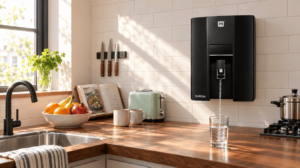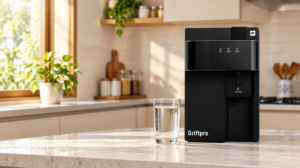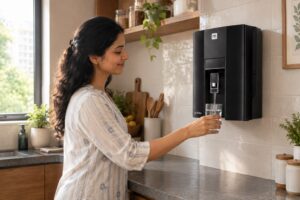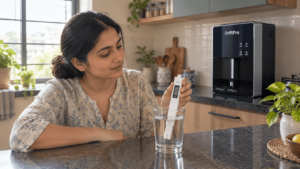


India’s rapid urbanisation, unfortunately, brings a rising concern: water contamination, even within municipal supplies. You might think your piped water is safe, but its quality varies wildly across cities. Sources can range from clean, chlorine-treated water to borewell water with very high Total Dissolved Solids (TDS), or water contaminated due to old, leaking pipelines. This uncertainty makes choosing the right water purifier for home a critical decision for your family’s health. We understand this challenge. This comprehensive guide simplifies the decision process, helping you find the perfect water purifier for your home in your specific urban setting.
Also Read: How To Choose The Best Water Purifier For Home In Delhi
Common Drinking Water Problems in Indian Homes
Urban water sources present a variety of challenges that necessitate a good water purifier for home. It’s not just about what comes from the source; it’s also about what happens on the way to your tap.
1. Chlorine and Sediments in Treated Water
Municipal water, while treated, is generally disinfected with chlorine to kill microbes, but this chemical remains in the water and can affect its taste and smell. Furthermore, despite municipal treatment, the water can still contain residual bacteria and fine sediments (dust, silt).
2. High TDS and Heavy Metals in Borewell Water
In many city areas, families rely on borewell or tanker water. This source often contains a significantly higher concentration of TDS, which are primarily inorganic salts like calcium, magnesium, and sodium. More worryingly, this water can also be contaminated with harmful substances like heavy metals (such as lead or arsenic) and industrial run-off, making a robust purification system essential.
3. Contamination from Old Pipelines
Even in areas with good municipal supply, the water can become compromised after it leaves the main line. Old, cracked, or rusted pipelines are common in older urban localities. These lines can allow surface run-off and sewage to seep in, contaminating the clean supply with pathogens and rust particles, demanding a versatile water purifier for home with multi-stage filtration.
Also Read: 9 Benefits Of Renting An RO Water Purifier For Home
Different Types of Water Purifiers and Their Uses
Choosing the right water purifier for homes fundamentally depends on the contaminants present in your specific water supply. It is essential to remember that different technologies address different problems.
1. RO (Reverse Osmosis) Purifier
This technology is the gold standard for areas with high water hardness or high TDS (above 500 ppm). The RO membrane effectively removes difficult impurities like heavy metals (lead, mercury) and excessive dissolved salts. The drawback is that the process is slow, requires electricity, and results in some water wastage.
2. UV (Ultraviolet) Purifier
UV purification is best suited for municipal water that has low TDS but needs disinfection. The UV lamp deactivates all known bacteria and viruses, making the water microbiologically safe. It works instantly and does not waste water or change the taste, but it does not remove any dissolved solids like salts or chemicals.
3. UF (Ultrafiltration) Purifier
UF purifiers use a fine hollow fibre membrane to filter out suspended solids and microorganisms. They are excellent for filtering sediment issues and can operate without electricity. However, UF is unsuitable for hard water as it cannot remove the dissolved salts or high TDS.
4. Activated Carbon Filter
Primarily used as a pre-filter or a polishing stage, activated carbon is highly effective at removing chlorine, pesticides, bad odour, and organic impurities. It is an ideal addition for city water supplies where taste and smell are concerns.
5. RO+UV+UF Hybrid Purifiers
In large metropolitan cities where the water source frequently changes (e.g., municipal water on some days, tanker water on others), a hybrid model is most practical. These multi-stage purifiers combine the power of RO to reduce TDS, UV to sterilise, and UF to remove suspended particles, ensuring comprehensive protection for the water purifier for homes.
Also Read: 6 Benefits Of RO Water Purifiers for Your Home In Bangalore
How to Choose the Best Water Purifier for Urban Homes
Choosing the correct purification technology is crucial to ensure clean and safe drinking water, and the ideal water purifier for homes varies significantly by city based on the local water quality.
Cities with Low-TDS Municipal Supply
In metropolitan areas like Delhi, Mumbai, and Bangalore, which primarily receive treated municipal water, the TDS levels are generally low. Here, the main concerns are microbial contamination and chlorine. For these cities, a simple UV purifier combined with an activated carbon filter is often sufficient and efficient. This combination ensures disinfection while improving taste and odour without wasting water.
Cities with High-TDS Borewell Water
In cities such as Hyderabad, Chennai, and Pune, reliance on borewell or ground water is high, leading to very high TDS levels. A standard UV or UF purifier cannot handle these dissolved salts. For these regions, an RO water purifier for home is mandatory. You should select a quality RO purifier for home with a powerful membrane to effectively reduce the TDS to safe levels. Consider an RO-only model if your budget is tight, or an RO+UV system for added microbiological protection.
Also Read: Best pH Level Of Drinking Water: Is 9.5 Good For You?
Options for Mixed and Variable Supply
Many urban localities, especially in major metros, face mixed water sources—sometimes municipal, sometimes tanker or borewell. Since the water quality constantly changes, you need a versatile solution. The best RO water purifier for home in this scenario is a Hybrid RO+UV+UF model. This multi-stage unit provides the assurance of RO for high TDS days and the benefits of UV/UF for softer, municipal water days, providing comprehensive protection with a robust water purifier for homes.
| Water Source | Common Issues | Recommended Purifier | Why It Works |
| Municipal Supply (Treated Tap Water) | Chlorine, bacteria, and mild sediments | UV + Carbon Filter | Kills germs, removes chlorine taste/odour |
| Borewell Water | High TDS, hardness, heavy metals | RO Purifier | Reduces TDS, removes dissolved salts & metals |
| Tanker Water | Mixed quality, uncertain TDS | RO + UV Purifier | Ensures safe drinking water regardless of quality |
| Mixed Sources (Common in Cities) | Varies (municipal + borewell/tanker) | RO + UV + UF Hybrid | Multi-stage purification for all contaminants |
| Old Piped Supply | Rust, dirt, sediment particles | UF + Carbon Filter | Removes rust & visible impurities without electricity |
Choosing the best water purifier for homes in urban India is essential for family health. Start by understanding your water quality—specifically the TDS level—to determine if you need the powerful filtration of an RO system, the reliable sterilisation of a UV purifier, or a hybrid model. If you are new to a city or prefer a flexible solution without high upfront costs and the hassle of maintenance, remember that RentoMojo offers a variety of advanced water purifiers on rent. This option makes accessing clean and safe drinking water simple and affordable. Check out now!
Frequently Asked Questions
1. How to choose the best water purifier for home?
To choose the best water purifier for homes, first test your water’s TDS and source. For high TDS or borewell water, an RO purifier is ideal. For municipal water with low TDS, UV or UF purifiers are sufficient. Always compare filter stages, capacity, and after-sales service before finalising.
2. Which water purifier is the best for municipal water?
For municipal water supply, a UV or UF water purifier is usually the best option. These systems effectively remove bacteria, viruses, and chlorine without stripping essential minerals, making them suitable for homes with low TDS water.
3. Which is better, RO or RO UV?
RO purifiers are best for removing dissolved salts, heavy metals, and high TDS. However, an RO UV purifier offers double protection—it reduces TDS and also kills bacteria and viruses. If your home water has both high TDS and microbial risk, RO UV is the better choice.
4. Is a RO filter required for municipal water?
In most cases, RO is not required for municipal water because TDS levels are usually low (below 300 ppm). A UV or UF purifier works well. However, if your municipal water supply has higher TDS or chemical contamination, then an RO purifier may be necessary.
5. At what TDS level is RO required?
An RO water purifier is required when TDS levels exceed 500 ppm. At this range, water tastes salty and may contain harmful salts or heavy metals. For TDS between 50–300 ppm, a UV or UF purifier is usually sufficient for homes.