
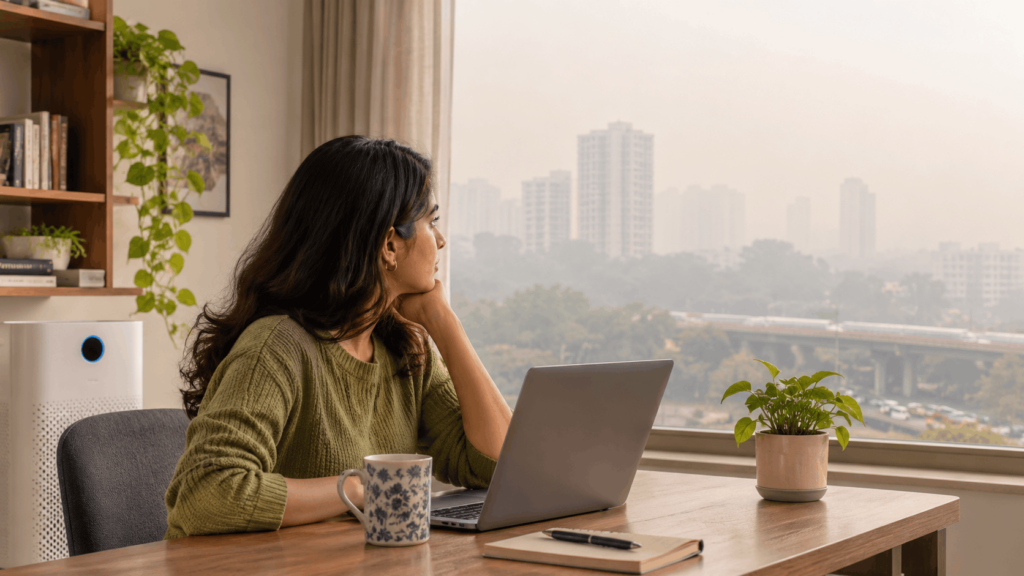
The AQI in Delhi has stayed in the ‘poor’ to ‘very poor’ range for most of November. The Central Pollution Control Board (CPCB) recorded 236 at 8 am on Monday, November 23. Earlier this month, according to a PTI report, Delhi Environment Minister Manjinder Singh Sirsa directed 50% of the employees under his department to work from home. Transport Minister Pankaj Singh issued similar instructions for his workforce.
Work from home was first used in October, before Diwali, when Delhi saw its worst Diwali AQI in five years. As people get used to WFH, it’s worth checking whether home air is clean enough. Air purifier sales are rising, and air purifier rentals have also seen a jump. The number of repeat buyers is increasing as people add more purifiers to their homes. So can WFH bring real relief during the AQI crisis?
Key takeaways
- AQI in Delhi was 236 (‘poor’) at 8 am on November 23, 2026, according to CPCB data, with PM2.5 as the main pollutant.
- GRAP Stage III was revoked on November 17, while Stage II curbs remain across Delhi-NCR.
- Indoor particle levels in Delhi homes were 1.6 times higher than outdoor levels in January, according to a Delhi University study.
- An air purifier lowers indoor AQI only when its CADR matches the room’s volume multiplied by about five air changes per hour.
- Rentomojo rents air purifiers in Delhi from ₹500/mo on a 36-month plan, against ₹12,000–₹18,000 to buy one.
Also Read: Does an Air Purifier Work in Delhi? Find Out Everything Here!
What Is the AQI in Delhi Today?
Delhi’s air has improved from its mid-November peak but has not left the ‘poor’ band. The Indian Institute of Tropical Meteorology (IITM) expects the AQI in Delhi to stay ‘poor’ until November 25.
| Date (2026) | AQI | Category | GRAP status |
|---|---|---|---|
| October 21 | 244 | Poor | Stage I invoked |
| November 2 | 324 | Very poor | Stage II invoked |
| November 6 | 382 | Very poor | Stage III invoked |
| November 9 | 391 | Very poor | Season high so far |
| November 16 | 216 | Poor | Stage III in force |
| November 19 | 286 | Poor | Stage III revoked on November 17; Stages I and II remain |
| November 23 | 236 | Poor | Stage II in force |
Source: CPCB readings via news reports. Live AQI: CPCB website or SAMEER app.
What Do AQI Levels Mean in Delhi?
CPCB’s National Air Quality Index has six bands. Delhi spent most of November in the ‘poor’ and ‘very poor’ bands.
| AQI | Category | Likely health impact |
|---|---|---|
| 0–50 | Good | Minimal impact |
| 51–100 | Satisfactory | Minor breathing discomfort for sensitive people |
| 101–200 | Moderate | Breathing discomfort for people with asthma, lung or heart disease, children and older adults |
| 201–300 | Poor | Breathing discomfort for most people on prolonged exposure |
| 301–400 | Very poor | Respiratory illness on prolonged exposure |
| 401–500 | Severe | Affects healthy people and seriously impacts those with existing illness |
Why Is the AQI in Delhi So High in Winter?
Pollution in Delhi builds up between November and January because the weather stops it from clearing. Cold, still air sits close to the ground and traps smoke and dust, while low wind speeds slow dispersal. Stubble burning in Punjab and Haryana, vehicle exhaust, construction dust and Diwali firecrackers add to the load. PM2.5 has been the main pollutant on most days this month.
Who Had to Work From Home Due to the AQI in Delhi-NCR?
Under the Commission for Air Quality Management (CAQM) directive, government and private offices could have no more than half their staff in the office. It covered Delhi and specific NCR districts, including Faridabad, Gurgaon, Gautam Buddha Nagar, Ghaziabad and Sonipat. The directive was released on October 30, 2026, for the period from November 5 to 20.
Departments such as environment, transport, health, IT administration, food and civil supplies allowed half of their workforce to work remotely. Corporate and private offices allowed 50% of their workforce to work from home, with the other 50% attending in person.
Also Read: Do You Need An Air Purifier For Home? Find Out The Truth!
Which Services Are Exempt?
Under the CAQM directives and Delhi-NCR’s GRAP Stage III rules, essential services are exempt from working remotely. People working in hospitals, clinics and direct health departments must work on-site.
Other than healthcare and medical services, personnel working in emergency services and disaster response, core civic utilities, public transport, pollution control, and prisons and security do not have the provision to work from home. Administrative secretaries and heads of departments must attend the office.
Is Indoor AQI in Delhi Homes Better Than at the Office?
Not necessarily. According to a Delhi University study (Yadav & Ghosh, Pollution 2022), indoor air in Delhi homes had particle levels 1.6 times higher than outdoor levels in January. Offices fare better only when their ventilation systems have well-maintained filters.
Does Cooking at Home Add to Indoor Pollution?
The paper “Indoor air quality assessment of particulate matter levels in urban homes in India”, published on ScienceDirect in 2025, found indoor particle levels around 30% higher during cooking than at other times. Homes that cooked for more than two hours a day saw about 40% higher readings. While LPG is widely used in Delhi kitchens, a settlement on the Delhi-Noida border was still found using firewood on mud stoves in winter.
Should You Keep the Windows Open When the AQI in Delhi Is High?
If you keep the windows open, indoor AQI will increase. On November 16, 2026, Delhi’s AQI dropped to 216 from 352 the morning before, but the air quality was still in the ‘poor’ category. The national health advisory recommends keeping windows and doors shut in the morning and late evening.
Delhi’s PM2.5 is likely to peak between 9 and 10 am in winter. Under Delhi’s winter schedule, municipal and government offices start at 8:30 am and 10 am. Keeping the windows shut through that peak helps most.
How to Ensure Cleaner Air for Home Offices
Keep an air purifier in your home office and keep the windows closed. If you are working from an open living and dining room, count that as one large room and choose an air purifier sized to the larger space.
Switch on the air purifier before you start working. In most homes, indoor air quality drops during cooking hours, so keep the exhaust on.
A home office needs an air purifier with the right Clean Air Delivery Rate (CADR). Make sure the CADR matches the room’s volume multiplied by around five air changes per hour.
Also Read: Air Quality in Gurgaon vs Delhi: Is Gurgaon More Polluted?
Is Renting an Air Purifier Sensible for a Work-From-Home Setup?
Usually, yes. For anyone who has moved to Delhi or Gurgaon for work and does not know how long they will stay, renting an air purifier avoids an upfront cost. Whether you are a fresher or a family, paying upfront for a machine you may have to move before a lease renewal or job change makes little sense, and renting suits that short window.
Buying a mid-range air purifier costs between ₹12,000 and ₹18,000, plus filter replacements and servicing.
Rentomojo offers monthly air purifier subscriptions in Delhi-NCR. On Rentomojo in Delhi, an air purifier that covers 300 sq ft costs ₹500/mo on a 36-month plan, as of November 16, 2026. Plans start at 3 months, with 6- and 11-month options for short-term needs, which suits anyone dealing with seasonal AQI spikes.
How Does a Three-Month Plan Compare with Buying?
Buying a new mid-range air purifier costs around ₹12,000–₹18,000 in Delhi, while renting a similar model costs ₹638/mo, or ₹1,914 on a 3-month plan. Prices are subject to change based on availability and location on Rentomojo.
Subscription platforms charge a security deposit at the start of the rental. For example, Rentomojo adds a one-month deposit, which is refunded after the purifier is returned.
When Is Buying an Air Purifier a Better Choice?
Buying beats renting when you are likely to stay in the same place for more than 3 years. Those who own a house in Delhi-NCR and have no plans to relocate get more long-term value from buying. Households with older adults, children, or members with heart conditions or asthma may also find better value in owning a purifier.
Does WFH Help When the AQI in Delhi Is High?
It helps only if indoor AQI is lower than outside. In Delhi-NCR, indoor particle levels can go above outdoor levels, and cooking adds spikes. What works is an air purifier matched to the room size, with windows kept shut during peak hours. Whether to rent or own one depends on how long you will stay in the same home; buying suits those with no plans to move soon.
Also Read: Air Purifier in Mumbai: Do You Really Need One in Winter?
Frequently Asked Questions
1. How many cigarettes is 500 AQI?
If you breathe air at an AQI of 500 for 24 hours, it is equivalent to smoking 27 cigarettes per day. According to Berkeley Earth research, 22 µg/m³ of PM2.5 over 24 hours is roughly 1 cigarette per day in long-term mortality risk.
2. Which months have the worst AQI in Delhi?
Delhi’s air quality is usually worst from late October to January. Stubble burning, Diwali firecrackers, low wind speeds and cold, still air combine to trap pollutants near the ground.
3. Does an air purifier lower indoor AQI in Delhi homes?
An air purifier lowers indoor PM2.5 when its Clean Air Delivery Rate (CADR) matches the room. A common rule is a CADR equal to the room’s volume multiplied by about five air changes per hour, with windows kept shut.
4. What AQI is safe for children?
An AQI of 0-50 is safe for children. Above 100, AQI starts becoming unhealthy for kids. Children who have asthma or lung conditions need to be carefully watched as the AQI goes above 100.
5. Which Indian state has the worst AQI?
Delhi, Haryana, Uttar Pradesh, and West Bengal consistently record poor pollution levels, spiking the AQI.