

Summary: An under-sink water purifier goes under the sink, while a wall-mounted water purifier attaches to the wall. Both suit small kitchens in Delhi, but each has different installation requirements. Under-sink water purifier disadvantages often outweigh those of wall-mounted ones.
People living in rented flats find it extremely difficult to find the perfect water purifier that fits well in their kitchen. People start browsing under-sink water purifiers and wall-mounted water purifiers – both types feature RO and UV stages. The specifications are almost identical, which makes it hard to narrow your search. The choice often comes down to keeping the wall clear, faster water flow, easier relocation, or quicker checks. An under-the-sink RO water purifier keeps your kitchen clutter-free by hiding the unit. However, wall-mounted RO water purifiers are always on display, so they may not suit your kitchen’s aesthetics. To help you decide, here is a detailed comparison of under-sink water purification and wall-mounted RO systems.
Also Read: How To Calculate TDS for Drinking Water At Home
Under-Sink vs. Wall-Mounted Water Purifiers: What’s the Difference?
The key difference between wall-mounted and under-sink water filter systems is where you install them. Under-sink purifiers go under the cabinet, but you need to add a tap at the sink. Wall-mounted UV or RO purifiers are always on full display in the kitchen, but they are easy to install and check for malfunctions.
| Factor | Under-sink water purifier | Wall-mounted water purifier |
| Where it sits | Inside the cabinet below the sink | On the wall, usually beside or above the sink |
| Space it takes | Cabinet space; frees the wall and counter | Wall space; leaves the cabinet free |
| Tap | Separate RO tap fixed on the sink or countertop | Tap built into the front of the unit |
| Drilling needed | A hole in the sink or countertop for the tap | Screw holes in the wall or tiles for the bracket |
| Power point | Needed inside or near the cabinet | Needed on the wall near the unit |
| Reject water | Connects to the sink drain pipe under the cabinet | Pipe runs from the unit down to the sink or a drain |
| Leaks | Can go unnoticed inside a closed cabinet | Visible on the wall and floor |
| Servicing | Technician works inside the cabinet | Unit is at eye level and easy to open |
| Suitable for | Modular kitchens with a closed sink cabinet | Open slabs, small cabinets, rented flats |
Under-Sink Water Purifying System: What Is It and How Does It Work?
An under-sink water purifier goes under the kitchen sink. It connects to the cold water supply. The unit delivers purified water through a separate tap on the sink or countertop. Under-sink water purifiers are also sold as under-counter purifiers. The only part of the under-sink water purifier you see is the tap; the rest stays behind the kitchen cabinet.
Here’s how under-the-sink water purification works:
1. A valve on the cold water line under the sink feeds water into the unit.
2. The water passes through the sediment and carbon filters. Then it passes through the RO membrane and the copper/mineral stage.
3. Purified water is stored in the water storage tank, and then the water is set up at the RO tap for the sink.
4. Reject water from the RO membrane comes out of the sink’s drain pipe. You need a drain connection for RO wastewater.
Also Read: Buying an RO vs RO on Rent in Delhi: AMC, Filter Changes
Different Types of Under-Sink Water Filters
There are several types of under-the-sink water filters, but you need to check the space under the sink for height, width, and depth. If it’s a multi-stage RO, it might take more space. Here are the common under-the-sink water filters to consider:
1. Activated Carbon Filtration System
If you need better taste or to remove odour, an activated carbon filtration system can help. It uses carbon blocks or granular activated carbon to absorb impurities. The advantage is that the system doesn’t waste water or remove beneficial minerals. However, it can’t reduce hard water minerals or TDS.
2. Reverse Osmosis System
An under-the-sink RO water purifier removes heavy metals, fluoride, and high TDS. It forces water through a semi-permeable membrane, along with running sediment and carbon stages. An under-the-sink RO offers premium purification, but basic models can generate wastewater and strip natural minerals.
3. Ultrafiltration System
Also known as a UF system, it uses a hollow membrane with larger pores than RO. It works without high pressure or electricity. UF removes bacteria, viruses, and concentrated solids while keeping natural minerals intact. It produces no wastewater, but it does not remove dissolved salts or lower TDS.
4. Multi-Stage Purification
RO multi-stage combines carbon, RO or UF, UV lamps, and specialised mineral/alkaline or copper cartridges into one unit. It offers comprehensive protection against various water sources.
Always check the ‘filters’ mentioned in the box of an under-sink water purifier. A pre-filter cannot bring down TDS levels. You need RO membranes for high TDS.
What is a Wall-Mounted Water Purifier?
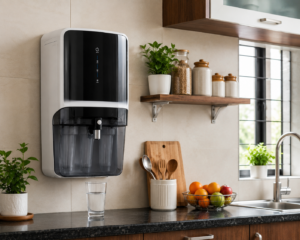
Widely seen in most Delhi households, a wall-mounted water purifier is a unit fixed to the kitchen wall. The purifier comes with filters, a storage tank, a tap, and indicator lights on the body. Many wall-mountable RO water purifiers can also stand freely on the countertop.
For a wall mount RO, the water comes from the inlet through a pipe. The unit purifies the water inside and dispenses it from the front tap. A pipe always runs down into the sink to drain wastewater. Unlike an under-the-sink purifier, you can see the purifying lights at a glance.
Also Read: Can You Drink Hard Water in Delhi? Find Out What Happens
Should You Get an Under-Sink Water Purifier?
The main benefit is that the water purifier declutters the kitchen. This matters for modular kitchens because they create a uniform, aesthetic look.
1. Under-the-Sink Purifiers Free Up the Wall: Wall-mounted water purifiers may obstruct the overall look of the kitchen. Under-the-sink water purifiers do not take up space. Only the tap is on the counter.
2. It Matches the Look of a Modular Kitchen: In modular kitchens, you will always see matching cabinets. In a modular kitchen, an RO unit with a drain pipe stands out. An under-the-sink purifier remains behind the cabinet doors, so the kitchen’s look remains uninterrupted.
3. RO Wastewater Goes Straight into the Drain: An under-the-sink water purifier sits next to the sink’s drain pipe; the reject line is short and stays hidden. A wall-mounted RO has the pipe running from the unit down to the sink, which remains visible and can slip out of the sink.
4. A dedicated RO Tap at Sink: An under-sink unit is like a dedicated water purifier for sink. Drinking water comes from its own tap, and it sits beside the main kitchen tap. The main appeal is that you can easily fill bottles, kettles, and vessels with less spillage.
Under-the-Sink Water Purifier Disadvantages
The main disadvantage of an under-sink purifier is the space under the sink. You need to find a suitable hole for the tap and power point inside the cabinet. If there are leaks, you will not see them right away
1. Under-Sink Purifiers Need Free Space
The sink cabinet holds the drain pipe, the dustbin, and cleaning supplies. Sometimes cabinets are designed to store LPG cylinders. An under-sink purifier needs to make its own space around all of them. For example, the DrinkPrime Copper Under The Sink measures 210 mm x 350 mm x 320 mm (height). Check the cabinet’s height and depth before deciding.
2. A Hole for the Tap
You need to drill a hole in the sink deck or the countertop. If it is granite or quartz, the hole is permanent. For rented flats, you need your landlord’s permission before drilling. This may be a nuisance.
3. The Leaks Don’t Appear Right Away
If the purifier inside the cabinet drips because of a loose fitting, you may not notice it for days. This can cause the particle-board cabinet base to swell and weaken. It is important to open the cabinet and check the fittings once or twice a week.
4. Under-Sink Purifiers are Harder to Move
One of the biggest under-sink purifier disadvantages is that you cannot easily find a repair. Filter changes and repairs can take longer because local technicians may not be fully trained to replace parts. Irregular servicing can do more damage than it saves.
5. Under-Sink Purifiers are Expensive
An under-the-sink water purifier likely costs more than a wall-mounted RO. For example, the DrinkPrime Copper Under The Sink (6 L, RO+UV+Copper) costs ₹609/mo on a 12-month plan, against ₹423/mo for the wall-mounted DrinkPrime RO+ (6 L, RO+UV).
Also Read: TDS Levels In Water Purifier: What Is The Ideal Range?
Pros and Cons of Using a Wall-Mounted Water Purifier
Most people are familiar with wall-mounted water purifiers. Remember that a wall-mounted water filter differs from a purifier. The main trade-off between an under-sink purifier and a wall-mounted RO is the wall space it takes.
Pros of Using a Wall-Mounted Water Purifier
People are familiar with this type, making it easy to use. The following are other advantages of using a wall-mounted water purifier:
1. There’s no need for a cabinet: For kitchens with an open slab and no cabinet, a wall-mounted RO is a suitable option. In such simple kitchens, under-the-sink water purifiers have nowhere to go.
2. Water purifier servicing: Water purifier servicing is a headache, but you can find a technician without hassle. The unit sits at eye level, so you don’t need to clear out the cabinet.
3. No hole in the countertop: Wall-mounted water purifiers do not need a hole in the kitchen countertop. You can mount the unit on the wall as long as there is a nearby power socket.
4. Easy to diagnose: If the unit needs to be recharged or the indicator light keeps blinking, it is easy to spot on the wall-mounted RO water purifiers. The devices are easy to service.
5. Easy installation and relocation: Wall-mountable RO purifiers fit into a bracket and need a power socket. Otherwise, they require minimal drilling into the wall or kitchen counter. Hence, you can install and shift the purifier.
Cons of a Wall-Mounted Water Purifier
Wall-mounted RO purifiers may obstruct the view of an aesthetically curated kitchen; however, there are no other major disadvantages.
1. Using wall space: In a small kitchen where there is a chimney or window, you need to position the wall-mounted RO accordingly.
2. Drilling is still required: For RO water purifiers, drilling is still necessary. The bracket needs 2-4 screw holes in the wall.
3. Bulky design: For small Delhi kitchens, the RO water purifier may seem bulky on the wall. Also, the pipelines are visible, unlike under-sink purifiers.
Also Read: How to Save RO Waste Water in Delhi and How to Reduce It
Under-the-Sink or Wall-Mounted Purifiers for Delhi Kitchens?
The choice depends more on your kitchen layout than on the purification technologies. Most of the units feature RO and UV stages.
1. Modular Kitchen With a Closed Sink Cabinet
Choose an under-sink water purifier if the cabinet has free height and depth, there is or can be a power point inside it, and you can drill a tap hole. This is the setup under-sink models are designed for.
2. Rented Builder Floor or Older Flat With an Open Slab
Go for a wall mounted water purifier. If your kitchen has an open slab or a masonry shelf under the sink, you won’t have a cabinet door to hide a unit behind. A wall-mounted RO needs only a few screw holes, which is a smaller change to ask a landlord for than a hole in the countertop.
3. Small Kitchen With a Crowded Sink Cabinet
Choose a wall-mounted water purifier if the cabinet already holds the dustbin, cylinder, or cleaning supplies. Squeezing an under-sink water purifier in leaves no room to reach the fittings when you need to check them.
4. You Expect to Move Within a Year
A wall-mounted water purifier is a better choice for people who move frequently. Your next kitchen may not have a cabinet that fits an under-sink water purifier, while a wall-mounted unit fits on almost any kitchen wall.
Also Read: Best Water Purifier for Home in Delhi (2026): A Complete Guide
Wall-Mounted vs. Under-the-Sink Water Purifier: Installation Requirements
The installation makes the real difference between a wall-mounted RO and an under-the-sink RO. The purification technologies are almost similar.
Installing a water purifier under the sink usually involves:
1. Fitting a valve on the cold water line below the sink.
2. Drilling a hole in the sink deck or countertop and fixing the RO tap.
3. Connecting the reject water line to the sink’s drain pipe.
4. Placing the unit and tank in the cabinet and plugging it into a power point.
5. Flushing the system before the first glass is drawn.
Installing a wall mounted water purifier usually involves:
1. Drilling holes in the wall and fixing the bracket.
2. Hanging the unit and connecting the inlet pipe from the water line.
3. Running the reject water pipe to the sink or a drain.
4. Plugging into a nearby socket and flushing the system.
If you choose DIY installation, keep in mind that a wrong connection may go unnoticed at first. It is better to leave purifier installation to a technician.
Under-Sink and Wall-Mounted Water Purifiers in Delhi
Rentomojo, a furniture and rental platform operating since 2014, offers under-sink and wall-mounted RO purifiers on rent in Delhi.
| Model | Type | Purification | Capacity | Dimensions (as listed) | Rent (excl. GST) | Refundable deposit |
| DrinkPrime Copper Under The Sink | Under sink | RO+UV+Copper, 5-stage, IoT | 6 L | 210 x 350 x 320 mm | ₹609/mo, 12-month plan | ₹1,999 |
| DrinkPrime RO+ | Wall mounted | RO+UV, 4-stage, IoT | 6 L | 350 x 210 x 520 mm | ₹423/month, 12-month plan | ₹1,499 |
| DrinkPrime Alkaline | Wall mounted | RO+UV+Alkaline, 5-stage, IoT | 8 L | 330 x 230 x 490 mm | ₹572/mo, 12-month plan | ₹1,499 |
| NiraFlo | Wall mounted | 7-stage with alkaline boost | 7 L | 16 x 11 x 20 in | ₹417/mo, 36-month plan | ₹417 |
If you are comparing the best under-the-sink and wall-mounted water purifiers in Delhi, check the fit. Under-sink units only make sense if you have a cabinet, a tap hole, and a power point. If you’re missing any of these, consider a wall-mounted RO.
People who frequently move for work or business may not know whether their next flat will have space for an under-sink purifier. That’s why renting a water purifier may be a good option. If you rent an under-sink purifier and move to a flat with an open slab, or if the landlord won’t agree to drill holes in the countertop, renting offers more flexibility. Explore Rentomojo’s RO water purifier rentals in Delhi!