

Summary: Every RO purifier owner wonders how to save RO waste water. An RO is likely to waste 3-4L of water for every 1L of purified water. There are many uses of RO reject water, including mopping floors and cleaning cars. Etc. However, you should not use the waste water to wash your hair or cook. RO reject water can be collected for different uses, but users in Delhi, where supply is scarce, should ask the brand about the water recovery rate.
RO reject water is impossible to ignore in Delhi because of groundwater depletion and irregular water supply. Usually, an RO water purifier can reject 60-80% of the input water. If you are on borewell water, a reverse osmosis system is necessary to manage high TDS levels. That’s why many families wonder how to save RO waste water. There are a few things you can do with the RO reject water, but you should also learn about the size of an RO waster water storage tank, how to save the water, and when you should not use the waste water. Here’s a complete guide to RO reject water and what you should do with it.
Also Read: TDS Levels In Water Purifier: What Is The Ideal Range?
What is RO Reject Water?
RO waste water is the output an RO purifier sends to the drain after water passes through the membrane. According to the Central Pollution Control Board, it is high in TDS and contains “removed salts, minerals, and dissolved pollutants.” This makes the water in an RO waste water storage tank unsuitable for drinking.
| Recovery rate | Reject water per litre purified | Reject water per 20 litres purified |
| 20% (pre-2023 minimum) | 4 litres | 80 litres |
| 40% (current BIS minimum) | 1.5 litres | 30 litres |
| 50% | 1 litre | 20 litres |
Calculated: reject = purified volume × (1 − recovery) ÷ recovery.
TDS Levels of RO Reject Water
The TDS level of RO waste water depends on the feed water. At 40% recovery and typical 98% membrane salt rejection, RO reject water carries about 1.65 times the TDS of the water entering the purifier.
| Feed water TDS (mg/L) | Reference point | Reject TDS at 20% recovery | Reject TDS at 40% recovery |
| 200 | Low-TDS piped supply (example) | 249 | 331 |
| 500 | IS 10500 acceptable limit | 622 | 827 |
| 1,000 | Within IS 10500 permissible range | 1,245 | 1,653 |
| 2,000 | IS 10500 permissible limit | 2,490 | 3,307 |
Calculated by mass balance: reject TDS = feed TDS × (1 − recovery × 0.02) ÷ (1 − recovery).
Also Read: Water TDS Level in Delhi: Safe Limits and the Right Purifier
Why Consider RO Waste Water for Delhi?
As per the Economic Survey of Delhi 2025-26, Delhi’s projected water demand for 2025 was 1,250 million gallons per day. However, treated water capacity is 961 million gallons per day. The Delhi Jal Board’s Summer Action 2026 asked residents not to throw away RO waste water and to use it for mopping and cleaning.
The plan focuses on water conservation to bridge the supply gap during peak summer. The same plan maintained summer production at around 1,002 million gallons per day and deployed 191 departmental tankers. The Central Ground Water Board’s 2025 assessment puts Delhi’s stage of groundwater extraction at 92.10%, with 10 of 34 tehsils over-exploited.
Since a household with an RO water purifier produces non-drinking water every day and then sends it down the kitchen drain, it’s important to know how to save RO waste water.
Also Read: Best Water Purifier for Home in Delhi (2026): A Complete Guide
How to Save RO Waste Water in Delhi
You need to focus on two things –
1. Reducing how much the RO water purifier rejects
2. Saving the rest before it reaches the drain
A water purifier with a BIS minimum recovery of 40% discards about 1.5 litres for every litre purified. An RO waste water storage tank manages the second step.
1. Check the RO Recovery Rate
An older RO unit, manufactured before IS 16240:2023, is likely to waste more water. If the label does not have a recovery rate, you should ask the brand. A higher-recovery purifier can save waste water at the source, and it needs a smaller RO waste water storage tank. Among Rentomojo’s own purifiers, DriftLux features a 40% water recovery rate.
2. Collect RO Reject Water at the Drain Pipe
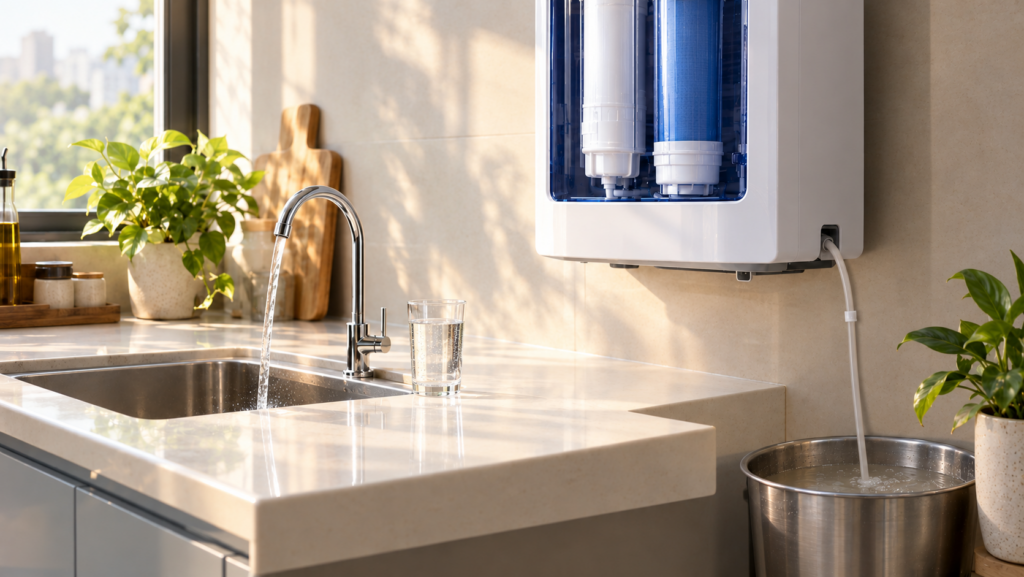
The easiest way to save RO waste water is to move the drain hose from the sink into a container. An adequate storage tank for reject water is a must. You can find a container to store the waste water.
3. Fix RO Wate Water That Keeps Running
Sometimes RO water purifiers quietly stop working when the internal tank is full. If water keeps trickling for hours with the tank full and nobody drawing water, it points to a defective shut-off. The fault can cause an RO waste water storage tank to overflow overnight.
Also Read: Can You Drink Hard Water in Delhi? Find Out What Happens
RO Waste Water Storage Tank: A Size Guide for Delhi Households
An RO waste water storage tank is a container at the purifier’s drain line. It holds reject water until it is reused. The CBCB’S 2026 guideline shows the size of the RO reject water storage tank suited to each household.
| Purified water used per day | Reject at 40% recovery | Reject at 20% recovery | RO waste water storage tank size |
| 10 litres | 15 litres | 40 litres | 18 L (40%) / 50 L (20%) |
| 15 litres | 22.5 litres | 60 litres | 30 L (40%) / 2 × 30 L (20%) |
| 20 litres | 30 litres | 80 litres | 30–50 L (40%) / emptied twice daily (20%) |
A 30-litre RO waste water storage tank covers most current purifiers in a small family flat. On an older 20%-recovery unit, the same RO waste water storage tank fills before lunch.
The user must also keep the RO reject water storage tank clean. Empty it daily and keep the lid shut to prevent mosquitoes from breeding. The waste water contains elevated levels of viruses, bacteria, and other organics.
Also Read: Do You Need an RO Water Purifier for Borewells in Delhi?
Different Uses of RO Waste Water in Delhi
There are three official sources that tell us how to save RO waste water in Delhi:
| Use | CPCB 2026 | DJB 2026 | NGT 2019 |
| Floor mopping and cleaning | ✓ | ✓ | ✓ |
| Toilet flushing | ✓ | — | ✓ |
| Vehicle washing | ✓ | — | ✓ |
| Utensil washing | — | — | ✓ |
| Plants and gardening | — | ✓ | ✓ |
1. For Toilet Flushing
Yes, the RO waste water can be used for flushing regardless of its TDS level. IS 1172 allows 45L per person per day for flushing. A family of four needs about 180 L a day for flushing alone. 30L from an RO waste water storage tank can cover 5 full flushes of 6 L on an IS 774 dual-flush cistern. You need to pour the bucket straight into the low because high TDS can scale the flush valve.
2. For Mopping Floors
Yes. Mopping is the only use on all three official lists. Fill the mop bucket from the RO waste water storage tank tap and add floor cleaner as usual. On dark granite or polished marble, dry the floor afterwards, since evaporating reject water leaves white marks.
3. For Washing Utensils
For soaking and scrubbing, yes; the NGT’s 2019 list includes utensil washing. Keep a basin filled with RO wastewater from the RO waste water storage tank for greasy pans and steel vessels, then give everything a final rinse in tap water to avoid a chalky film.
4. For Cleaning Cars
Yes. CPCB and the NGT both include vehicle washing. Carry a bucket from the RO waste water storage tank to the parking area instead of running a hose. Wipe cars and two-wheelers dry so dissolved salts don’t leave spots on the paint.
5. For Watering Plants
It depends on TDS. CPCB’s 2026 list leaves out gardening, while the NGT and DJB include it. FAO Irrigation and Drainage Paper 29 classifies irrigation water by salinity:
| TDS of water | FAO Restriction on use |
| Below 450 mg/L | None |
| 450–2,000 mg/L | Slight to moderate |
| Above 2,000 mg/L | Severe |
You should check the RO waste water with a TDS meter if you want to water your plants. If the TDS level is between 450 and 2,000 mg/L, you should mix the waste water with tap water for ornamental plants. When the TDS is above 2,000 mg/L, it is better to avoid it.
Also Read: RO Water For Hair Wash: Is It A Good Idea?
When to Avoid RO Waste Water for Daily Use
RO waste water can be used for many things but not for drinking, cooking, or bathing.
1. Is RO Waste Water Good or Bad for Bathing?
No, you should not use RO reject water for bathing or washing your hair. Its high TDS level can dry out your skin and cause rashes or itching. RO waste water can also damage hair, leading to breakage. It contains minerals, salts, and impurities at high concentrations.
2. Is RO Waste Water Good for an Air Cooler?
You can use it, but it is better to avoid it for two reasons. High TDS and salt concentrations lead to faster scaling and white crust deposits on the cooling pads. It reduces cooling efficiency over time. Additionally, stagnant, high-salinity water can lead to algae or bad odour if you leave it in the tank too long.
3. Can You Use RO Reject Water for an Inverter Battery?
No, the RO waste water contains concentrated minerals, dissolved salts, and heavy metals. The additional ions and impurities react with the internal lead plates and sulfuric acid electrolyte. This causes rapid plate sulfation, internal short circuits, and battery failure.
Also Read: Buying an RO vs RO on Rent in Delhi: AMC, Filter Changes
RO Water Purifier on Rent in Delhi
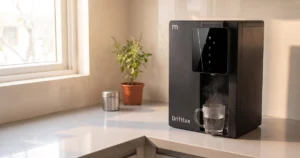
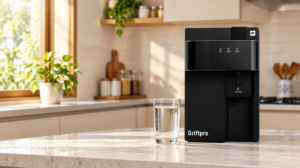
Rentomojo’s own RO water purifier, DriftLux, reports a 40% recovery rate. The tank size indicates how much reject water every refill produces. Refilling DriftLux’s 8.5 L tank at its listed 40% recovery sends about 12.75L to the drain, or to an RO waste water storage tank.
| Model | Purification | Purifier tank | Max input TDS | Recovery rate | Rent, 12-month plan | Rent, 36-month plan |
| DriftLux | 7-stage RO + UV + UF + Alkaline + Copper + TDS; ambient, warm and hot water | 8.5 L | 2,000 ppm | 40% | ₹839/month | ₹822/month |
Remember, not every household needs an RO water purifier. The requirement depends on the TDS level. Rentomojo’s Nirapure, a UV+UF purifier, is designed for TDS below 200 ppm. RO purifiers have RO membranes and reject streams. If you need an RO purifier, you will figure out how different uses of RO reject water. Visit Rentomojo to find the best water purifiers on rent in Delhi!
Frequently Asked Questions
1. Can RO reject water be used for washing clothes?
Yes, you can wash clothes with RO reject water. RO systems give you about 3L of water for every 1L they purify.
2. How to dispose of RO reject water?
You can use RO reject water for mopping and floor cleaning, watering plants, washing utensils, flushing toilets, and outdoor cleaning. The waste water contains high levels of dissolved salts, which makes it unsuitable for drinking.
3. Can I wash my hair with RO waste water?
No, you should not use RO reject water to wash your hair. RO reject water contains concentrated rejected salts and heavy metals. The water is more mineral-heavy, and washing hair with it can increase hair fall.
4. Can we use RO waste water for cooking?
No, the high TDS in RO reject water makes it unsafe for cooking. Boiling the water does not remove the total dissolved solids.
5. Is RO reject water safe to drink?
No, RO reject water is not safe to drink. An RO system pushes water through a membrane, leaving minerals and salts behind. Consuming RO reject water can upset your stomach or lead to long-term kidney or liver issues.