

TL;DR: Induction cooktops are generally more energy-efficient (85–90%) than LPG cylinders (40–55%), but the running cost in India depends on electricity tariffs. In most urban homes, induction cooking can cost ₹720–₹1,200 per month, while gas costs ₹900–₹1,100, making both nearly comparable.
Choosing between an induction cooktop and LPG goes beyond your preferred cooking style. It has become more about how much you can save on electricity and whether you can make any savings on your overall budget. The domestic gas cylinder prices are reaching ₹940, adding stress to Indian households. While Indian kitchens widely relied on gas cylinders, the perception is slowly changing. At a glance, LPG may last a month, but an induction cooktop does not require refills. The latter can aid in faster cooking and lead to no heat loss.
However, the question is – does better energy efficiency mean lower monthly expenses? How many units do induction stoves consume? In Indian families, cooking goes on for 2-4 hours daily. Even a slight change can affect your monthly budget, as induction tops can reach 85-90% efficiency. So, can induction top beat the LPG burners that convert about 40-55% of energy? To understand whether you should continue using LPG gas or switch to an induction cooktop, here’s what you need to know.
Also Read: How To Get A New Gas Connection: Online And Offline Modes
Induction Cooktop vs LPG Cylinders: Which is More Efficient?
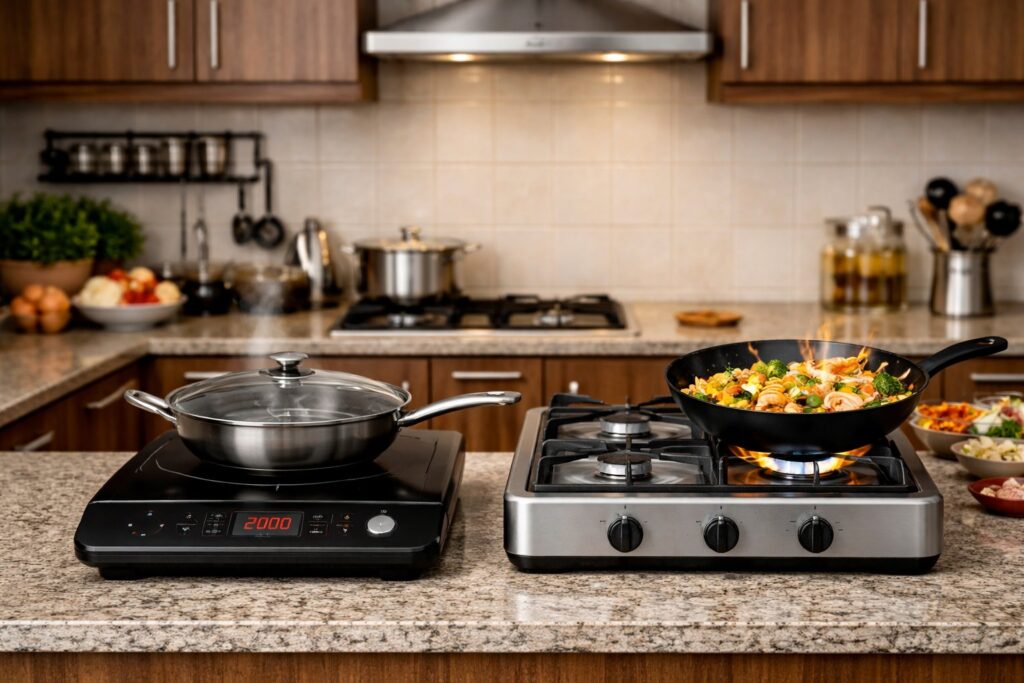
Cooking with an induction cooktop is more efficient than gas burners. In comparison to gas burners, they convert 85-90% of energy into heat. However, you should remember that the induction top heats the cookware using electromagnetic energy. Unlike an LPG stove, there is minimal heat loss. So, almost all the energy goes into cooking.
As gas stoves rely on an openDomestic gas cylinder prices are reaching ₹940, adding to the stress on flame, a large portion of heat escapes around the vessel. The temperature in the kitchen increases due to wasted heat. As a result, cooking a dish on a gas stove takes longer than cooking on induction.
Also Read: Induction Cooktop vs LPG: Which One Is A Better Option?
Is Using LPG Cheaper than Cooking on Induction?
No, if we look at the prices, cooking gas is not a budget option anymore. A 14.2 kg LPG cylinder costs around ₹913 and ₹965 because the gas stove wastes its generated heat.
An induction cooktop uses around 1.2 to 1.5 units of electricity to do the same amount of cooking as a gas cylinder. At an average urban rate of ₹7–₹8 per unit, your daily cooking cost stays under ₹12, compared to roughly ₹30 per day for an LPG cylinder that lasts a month. Due to the supply chain issues, LPG cylinders have become expensive. If you want to cut down your monthly budget by 30-40%, you can use an induction gas stove.
1. Estimated LPG Prices
On average, Indian households (a family of 3-4 members) use one cooking gas cylinder per month. The LPG gas prices range between ₹913 and ₹965, so monthly expenses for cooking gas may be around ₹1,100 per month. However, the LPG cost may vary depending on a few factors, such as:
- Cooking habits
- Frequency of cooking
- Number of people in a household
2. Estimated Induction Expenses
How much you will spend depends on the induction cooktop wattage and cooking time. If you want to calculate how much you will spend on cooking on an induction stove, here are a few things to consider:
- Power rating: 1,500 – 2,000 watts
- Daily usage: 2-3 hours
- Electricity cost: ₹6–₹10 per unit
- Monthly consumption: ~90–120 units
Buying a basic induction cooktop costs around ₹1,200-₹2,000. If you do not have induction-compatible utensils, you will have to spend ₹500–₹2,000 extra. Also, you need to keep in mind that electricity tariffs are higher in some states.
| Aspects | LPG Gas | Induction Cooktop |
| Monthly cost | ₹900–₹1,100 | ₹720–₹1,200 |
| Upfront cost | Low | ₹1,200–₹3,000 |
| Cost predictability | Stable | Depends on the tariff |
Also Read: How To Transfer Gas Connection: A Complete Guide For You
Should You Get an Induction or LPG Cylinder?
There is no specific answer to which one you should use for your household. While calculating, you should consider where you live, your monthly expenses, and electricity access. Induction cooktops are a better option if you have stable electricity in cities. You can use it for faster cooking and lower electricity consumption. If you are on a tight budget, a gas induction cooktop is a better choice for the long term. Induction is a great option to reduce energy waste and aid in overall savings. For short-term use and no budget constraints, gas is a better choice.
For rural areas, gas burners can help you when frequent power cuts are an issue. Also, you might face voltage fluctuations that affect cooking speed. Traditional dishes like roti and phulka require a high flame, and you may reap more benefits from LPG. Cooking with an induction cooktop is not a smart option for areas with inconsistent electricity.
However, many households keep an induction countertop stove as a backup alongside an LPG stove. You can use induction for boiling water and milk, and make traditional dishes with LPG. In case of power cuts, you can quickly switch to an LPG gas cylinder. Also, high LPG cylinder prices and shortages are other reasons to keep an induction cooktop at home.
Also Read: How To Apply For 5 KG Gas Cylinder: Steps, Price, Documents
Last-Minute Thoughts
When you decide between an induction top and an LPG cylinder, it is more about a strategic decision. The cooking gas might feel like a familiar and versatile option, but the rising LPG gas price is hard to overlook. Cooking on the induction cooktop converts around 90% of energy into heat with almost zero wastage. For Indian families, this is 30-40% cheaper than solely relying on LPG cylinders. It is best to maintain a hybrid setup; you can use an induction for bulk cooking and gas for traditional Indian dishes.
In case you are wondering whether you should go all in and buy an induction, it’s better to start with renting at first. You can rent an induction top from Rentomoo and test whether you can actually save anything. So, visit Rentomojo and check out our induction cooktops on rent!
Also Read: How To Apply For HP Gas New Connection Online & Offline
Frequently Asked Questions
1. What is the cost of an induction cooker per hour?
An induction cooktop costs roughly ₹8 to ₹20 per hour in India, depending on its wattage and electricity tariff.
2. Does induction use a lot of electricity?
While induction appliances have high wattage, they cook food faster and waste less heat. This means total energy consumption stays controlled.
3. Can we use an induction stove for more than 30 minutes?
Yes, induction cooktops can be used continuously for long durations, including more than 30 minutes.
4. Can induction get as hot as gas?
Yes, induction cooktops can reach temperatures similar to or even higher than gas stoves.
5. What are the health hazards of using an induction cooktop?
Induction cooktops are generally safe and have minimal health risks when used properly.
6. Is induction cooking cheaper than gas in India?
Induction cooking can be cheaper than LPG in India, depending on electricity tariffs and usage habits. Induction stoves convert around 85–90% of energy into heat, while gas stoves lose more heat. If your electricity rate is moderate and you cook daily, induction may reduce monthly costs. However, in cities with high power tariffs, LPG can still be more economical for heavy cooking needs.
7. How much power does an induction stove consume?
An induction stove typically consumes between 1,200 watts and 2,000 watts, depending on the model and heat setting. Lower settings use less power, while higher temperatures for boiling or frying consume more electricity. Most modern induction cooktops are energy-efficient and include auto shut-off features, helping you manage consumption better during everyday cooking tasks in Indian households.
8. How much power does a 2,2000-watt or 2,000-watt induction electricity consume per hour?
A 2,000–2,200-watt induction cooktop consumes about 2 to 2.2 units (kWh) of electricity per hour when used at full power. In real-life cooking, it rarely runs at maximum continuously, so actual consumption is lower. For example, cooking a meal may use around 1 to 1.5 units, depending on duration and heat levels used.
9. What is the alternative to LPG gas?
Common alternatives to LPG gas in India include induction cooktops, electric coil stoves, PNG (piped natural gas), and solar cookers. Induction stoves are the most popular due to efficiency and safety. PNG is widely available in metro cities and offers a continuous gas supply. Electric and solar options are useful in areas where LPG access is limited or for eco-conscious households.
10. Which type of utensils can be used on an induction?
Induction cooktops require utensils made of ferromagnetic materials like stainless steel or cast iron. The base must be flat and magnetic to work efficiently. Aluminium, copper, or glass cookware will not work unless they have an induction-compatible base. Many Indian cookware brands now offer induction-friendly pressure cookers, kadais, and tavas for convenient daily cooking.
11. Mention the 1400-watt induction cooktop’s electricity consumption.
A 1,400-watt induction cooktop consumes about 1.4 units (kWh) of electricity per hour at full power. In typical usage, such as cooking dal or sabzi, it operates at varying power levels, so actual consumption is lower. On average, a single cooking session may use around 0.8 to 1 unit, making it a reasonably efficient option for small families or light cooking needs.