

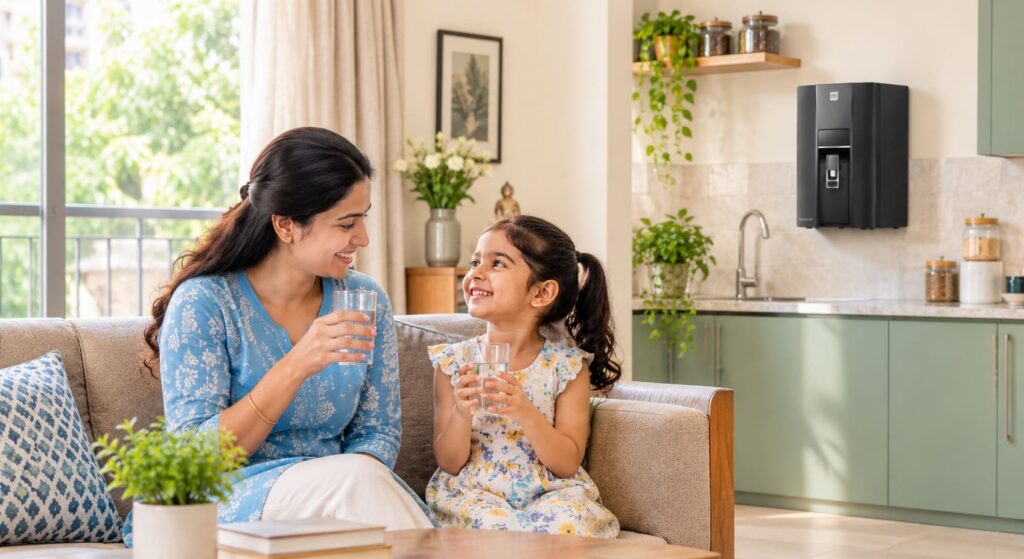
Most Mumbai homes get BMC piped water supply. These households have low TDS; hence, the requirement for an RO is also low. Mumbai gets water from lake-fed sources; this is the reason why the amount of dissolved solids is not as high as in borewell water. However, the water is not completely clean. The water travels through old pipelines and is stored in unclean storage tanks. You need a UV+UF water purifier to handle the risk of germs in the water. An RO water purifier for Mumbai is needed when the TDS is high.
Key Takeaways
- Mumbai’s water is clean, but it travels through pipes that may not be clean.
- Households on BMC-piped water supply do not need an RO.
- Check your water; if TDS is under 500 mg/L, you need a UV+UF. Over 500 mg/, you need an RO with a TDS controller.
Also Read: How to Rent Water Purifier in Mumbai: Monthly Plans & Pricing
Should You Skip RO Water Purifier in Mumbai?
For most households, yes. BMC supplies around 4,000 million litres every day. The sources are rain-fed lakes such as Bhatsa and the Vaitarna reservoirs. The water is treated at the Panjrapur and Bhandup plants. Lake water does not pick up a large amount of dissolved salts – only a few minerals. RO membranes are designed to remove the dissolved salts.
BMC tested the water, and only 0.99% of samples were found unfit for drinking in 2022-23. It was 0.46% for a couple of years and dropped to 0.28% in 2025-26. In 2025-26, fewer than 3 in 1,000 BMC samples failed in 2025-26.
In the last eight months of 2026, BMC received 1,514 contaminated water complaints, which were directed towards leaking connections. The complaints were linked to “passing through drains, house gullies and marshy soil.” Some samples fared worse than the city average. That’s why bacteria, cysts, viruses, and mud are what UV and UF water purifiers are designed for.
What Do RO, UV, and UF Water Purifiers Remove?
RO water purifiers remove dissolved salts, and UV and UF water purifiers shield against germs and sediment.
| Details | UV | UF | RO |
| Bacteria and viruses | Inactivates | Removes bacteria; partial on viruses | Removes |
| Cysts, mud, turbidity | Inactivates cysts; needs clear water | Removes | Removes |
| Dissolved salts (TDS) | No | No | Removes |
| Water wasted | None | None | Reject stream |
How to Choose a Water Purifier for Your Home in Mumbai
You need to choose a water purifier after considering what’s in your water. The multi-stage filters printed on the box come later.
1. Test the TDS: You can get a handheld TDS meter and use the meter for your water. Dip the meter and see the reading. This will tell you whether your building is on BMC, borewell, or tanker water.
2. Match the technology to the reading: High TDS calls for an RO; low TDS works out well with a UV or UF purifier.
3. Check for the BIS mark: If you need an RO purifier, ensure it meets IS 16240:2023.
4. Check servicing: UV lamps and UF membranes need to be replaced on schedule.
| Your TDS reading | Likely source | What to choose |
| Under 500 mg/L | BMC supply | UV+UF, plus activated carbon if chlorine taste bothers you |
| 500 to 2,000 mg/L | Borewell, tanker or mixed | RO+UV with a TDS controller |
| Over 2,000 mg/L | Poor groundwater | RO+UV, and get a lab test |
How Do You Choose an RO Water Purifier for Home with High TDS?
If your reading is above 200 mg/L, you need a high TDS water purifier. Three checks separate the best RO for high TDS from the rest.
You need to read the label for the recovery rate. Since December 2023, IS 16240:2023, domestic RO purifiers need to recover at least 40% of water. That’s why you will see a ‘rated recovery’ on the water purifier boxes. Even when the recovery rate is 40%, the purifier can send up to 1.5L down the drain for each litre you drink. Old RO units send around 4L.
If you can, check the reject water per litre purified. Then you can calculate from BIS recovery rates.
Then you should get a TDS controller or mineraliser when dealing with high TDS water. If you do not get one, the RO membrane can strip out every mineral.
Also Read: TDS Levels In Water Purifier: What Is The Ideal Range?
What TDS Should RO Water Have?
There is no exact minimum TDS for RO water. According to IS 10500, acceptable TDS in drinking water can be 500 mg/L. So, your goal should not be to look for zero TDS. You can get a unit with a TDS controller to balance the minerals.
Does RO waste increase your water bill?
Not really. BMC charges residential buildings about ₹6 per 1,000 litres. For a family using 15L of purified water a day, a unit with a 40% recovery rate discards about 8,200L a year. This nearly costs ₹50.
Also Read: RO Water For Hair Wash: Is It A Good Idea?
Which Rentomojo Water Purifier is Suitable for Your Mumbai Home?
You should choose a model whose rated input TDS covers your reading. Rentomojo’s UV+UF unit is rated for water under 200 mg/L, even though BIS accepts up to 500. A tap reading of 300 is drinkable, but you need an RO with a TDS controller to retain minerals.
| Your reading | Rentomojo’s water purifier | Technology and tank | Rated input TDS |
| Under 200 mg/L | Nirapure UV+UF (Non-RO) | UV+UF+minerals, 7 L | Under 200 |
| 200 to 2,000 mg/L | DriftGo 7 Stage | RO+UV+UF+minerals, 7 L | Up to 2,000 |
| 200 to 2,000 mg/L, bigger tank | DriftPro 7 Stage | RO+UV+UF+alkaline+copper, 8.5 L | Up to 2,000 |
| Up to 1,500 mg/L, doubtful tank water | RM Premium | RO+UF+in-tank UV+mineral enhancer, 6 L | Up to 1,500 |
| 200 to 2,000 mg/L, lowest stated waste | DriftLux 7 Stage | RO+UV+UF+alkaline+copper, hot water, 8.5 L | Up to 2,000 |
If you look, DriftLux has a 40% recovery rate. Rentomojo adds delivery and installation with each delivery. The in-house technician checks the TDS before and after installing the water purifier. Rentomojo includes free filter changes and maintenance for its own line of purifiers. Browse water purifiers on rent in Mumbai and compare to see which one is suitable for your household.
Also Read: Is Mumbai Tap Water Safe to Drink? Know What It Contains