

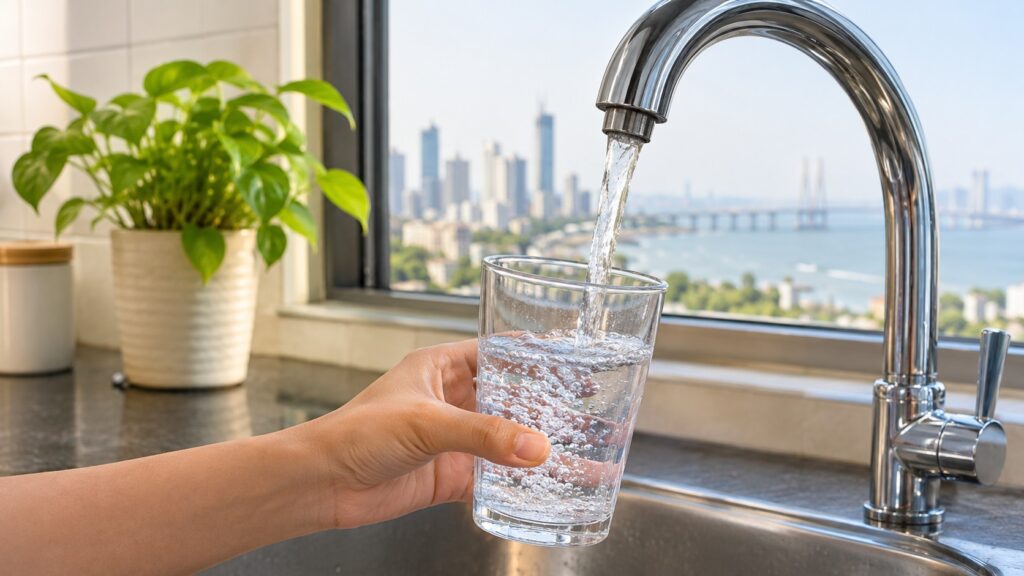
Mumbai tap water is generally considered safe. But the water is only drinkable when it leaves the plant. If you do not take any measures to purify it, the water carries a risk of contamination. This happens because of old building plumbing or unclean storage tanks. In 2019, a study by the Bureau of Indian Standards took samples from 21 cities, and only Mumbai’s sample passed every check. TDS value for tap water ranges between 80 and 320 mg/L. On the other hand, the TDS for groundwater averages around 719 mg/L.
You should know how safe your water is in Mumbai because it may be safe to drink at the reservoir but not from the kitchen tap. That’s why we will tell you what the BMC tap water contains, what happens during the monsoon, and how the water quality differs by area.
Also Read: Best Water Purifiers In Mumbai: How To Choose One For Home
How Often Does BMC Water Fail to Pass the Quality Check?
Not frequently, at the city level. According to the BMC’s Environment Status Report for 2025-26, 0.28% of water samples were unfit to drink. This makes 1 sample in every 357 samples. The BMC water lab tests 150-180 samples every day from service reservoirs and distribution points across 24 wards. During the monsoon, they test around 250 samples a day.
| Year (BMC ESR) | Unfit water samples, citywide |
| 2021-22 | 0.33% |
| 2022-23 | 0.99% |
| 2023-24 | 0.46% |
| 2024-25 | 0.46% |
| 2025-26 | 0.28% |
Sources: Free Press Journal, Aug 2025; Free Press Journal, Oct 2026
The tests check whether the water is at risk of contamination from sewage. The risk of bacterial growth is the foremost concern. On the other hand, people report on the water quality. Within the first eight months of 2026, BMC logged 1,514 contaminated water complaints. In September, it implemented a standard operating procedure to keep a round-the-clock check on the complaints.
Also Read: 8 Best Water Purifiers For Home: Which One Should You Choose?
What is the Source of Mumbai Tap Water? How is It Treated?
The original source of Mumbai tap water is seven lakes. Vihar and Tulsi are inside Sanjay Gandhi National Park, and the other five lakes are in Thane, Palghar, and Nashik. Together, these seven lakes supply about 4,000 million litres a day. Among these lakes, Bhatsa alone supplies about half of the city’s water. All of it is filled by monsoon rain.
| Lake | Approx. supply (MLD) |
| Bhatsa | 2,020 |
| Upper Vaitarna | 640 |
| Middle Vaitarna | 455 |
| Lower Vaitarna (Modak Sagar) | 455 |
| Tansa | 455 |
| Vihar | 90 |
| Tulsi | 18 |
Bhandup Water Treatment Complex is the largest one in Asia and has two units. It treats water from Tansa and the three Vaitarna lakes. The water supplies the western suburbs from Dahisar to Bandra, and the island city from Mahim to Malabar Hill. On the other hand, Panjrapur Water Treatment Plant treats water from Bhatsa, Vihar, and Tulsi. The plant supplies the eastern suburbs from Mulund to Sion, and Sion to Mazgaon.
The plants use the traditional treatment method. A coagulant is added so that mud and fine particles clump together. The clump settles out, and the water then passes through sand filters. In the end, the water is chlorinated to kill bacteria and viruses. The treated water flows to 27 service reservoirs across the city and from there into the distribution network that reaches your building.
Also Read: TDS Levels In Water Purifier: What Is The Ideal Range?
What Does BMC Tap Water Contain?
BMC tap water contains a small amount of dissolved minerals, chlorine, and very little else when the treated water leaves the plant. Lake water is rainwater, and it has spent a short time in contact with rock. So, it can gather minerals from the groundwater.
What is the TDS Level in Mumbai Tap Water?
TDS refers to the amount of minerals and salts in water, such as calcium, magnesium, chlorides, and bicarbonates. It is measured in mg/L or ppm. The BMC report only focuses on bacterial safety and does not disclose TDS levels. TDS levels in Mumbai range from 50 to 150 ppm for lake-fed supply. The reading is much higher when your building has a mix of borewell and tanker water.
Ideal TDS for Drinking Water
The WHO does not say anything about the ‘ideal’ TDS value of water regarding health concerns.
| TDS (mg/L or ppm) | WHO palatability rating | BIS IS 10500:2012 |
| Below 300 | Excellent | Within acceptable limit |
| 300 to 600 | Good | Within acceptable limit up to 500 |
| 600 to 900 | Fair | Above acceptable, allowed up to 2,000 only if no other source |
| 900 to 1,200 | Poor | Same as above |
| Above 1,200 | Unacceptable | Same as above |
Very low TDS in water does not mean the water is better right away. The WHO notes that low-TDS water tastes flat. The practical drinking water TDS range for most homes is around 50-300 ppm, and BMC water falls within this range.
Also Read: Best pH Level of Drinking Water: Is 9.5 Safe?
What about the Chlorine Added to Water?
BMC water can have a faint smell of chlorine on some days. India’s drinking water standard (IS 10500) requires at least 0.2 mg/L of residual free chlorine. The small amount kills germs as the water travels through kilometres of pipes. If you do not smell chlorine, your water may be in the storage tank for a long time.
How is TDS Related to Hardness?
Hardness refers to calcium and magnesium. If you leave white crust on the kettle or faucet, it is because of the excess levels of minerals. So, your water might have moderate TDS, but it may still feel soft because the dissolved solids are not calcium or magnesium. Lakewater is usually soft. But if you still see thick white deposits on your bathroom fittings, it means your building relies on borewell or tanker water.
What BMC Water Might Pick Up
When BMC water leaves the plant, it has been filtered and disinfected. The water does not have dissolved salts, fluoride, or salts often found in groundwater. It can pick up between the reservoir and your water purifier — mostly rust and sediment from old pipes, and bacteria from sewage enter through leakage.
Also Read: Ideal Range Of TDS Levels In RO Water: Know All About It!
What Happens to Tap Water During the Monsoon?
During the monsoon, the risk of contamination is the highest. Due to heavy rain, the soil in the lakes makes the raw water muddy. In the city, flooded and overflowing drains surround leaking service connections. Even though BMC checks around 250 samples every day, waterborne illness can increase every rainy season. When the rain starts, you should watch out for cloudy or brown water or a sewage smell. Ask the society if the storage tank has been cleaned.
Does Water Quality Differ by Area?
Yes, the water quality differs by a wide margin. Let’s look at the following:
| Ward (areas) | Unfit samples | Year |
| B (Dongri, Umarkhadi, Masjid Bunder) | 4.03% | 2025-26 |
| H-East (Bandra East, Khar East, Santacruz East) | 3.11% | 2025-26 |
| A (Colaba, Cuffe Parade, Nariman Point) | 1.5% | 2024-25 |
| T (Mulund) | 1.0% | 2024-25 |
| C (Kalbadevi), N (Ghatkopar), P-North (Malad, Malvani) | 0% | 2024-25 |
Source: BMC ESR 2024-25 and 2025-26, as reported by Free Press Journal
In older wards, especially where the density is high, the ageing pipes can be a persistent problem. The areas where service lines run through drains. Eastern and western suburbs are fed from lake water. Navi Mumbai follows a different system; the water mainly comes from Morbe Dam.
Also Read: RO Water For Hair Wash: Is It A Good Idea?
Which Water Purifier Do You Need for Tap Water in Mumbai?
For most households relying on BMC tap water, a UV+UF water purifier with a carbon filter is enough. BMC water is low in TDS, but it can pick up germs in the pipes. An RO water purifier on 60 ppm water wastes water and leaves you with water that has almost no minerals.
| Your water source | Typical TDS | Purifier you need |
| BMC supply only | Low (under 200 ppm) | UV + UF + activated carbon |
| BMC + occasional tanker water | Varies | RO + UV with a TDS controller or mineral cartridge |
| Borewell or mostly tanker water | Often 500+ ppm | RO + UV (the right water purifier for borewell water) |
| Old building, frequently cloudy or brown water | Any | Any of the above, plus a sediment pre-filter |
A handheld TDS meter can tell you the range of TDS in your water. If you notice sudden jumps on some days, your society might have a mixed water supply. Also, you might need an RO in this case.
No matter what purifier you choose, it depends on whether you maintain it well. Check for clogged UF membranes or dead UV lamps. Rentomojo’s own purifiers, including DriftGo, DriftLux, Nirapure, and DriftPro, are available with free filter changes every six months. When you know you will shift to another building and are not yet sure of the building’s water quality, renting a water purifier is practical. So, check out Rentomojo’s water purifiers on rent today!